Why SMA still rules test benches and when to choose SMP instead
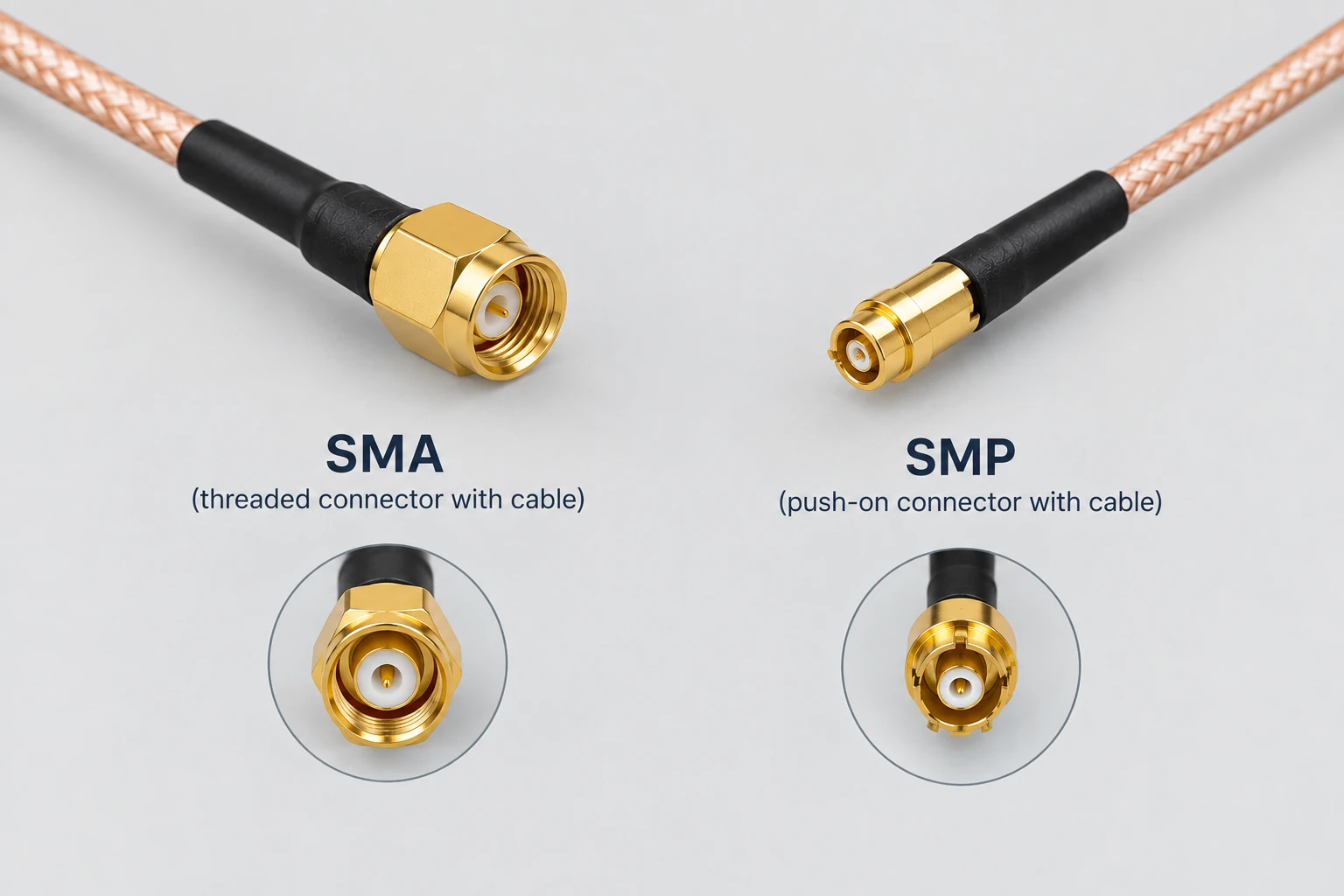
Walk into pretty much any RF lab in the country and you'll trip over the same thing: a drawer stuffed with SMA patch cables, half of them coiled wrong, all of them still somehow working after a decade of abuse. Meanwhile, over in the automated test cell down the hall, something quieter is happening. SMP connectors are sliding into place, no wrench required, no fuss, no drama.
SMA earned its spot on the bench and it's not giving it up without a fight. But SMP has real, tangible advantages once your problem becomes speed, density, or frequency headroom. This piece walks through the tradeoffs, gives you a few rules of thumb, and hopefully saves you from grabbing the wrong connector at 4pm on a Friday.
The basics, fast
SMA is the threaded, 50 ohm connector you already know. Hand-torqued, mechanically stubborn, found on nearly every instrument built since the Reagan administration. SMP is a different animal entirely, a sub-miniature push-on design built for blind-mate applications, still 50 ohm, still part of the same broad interconnect family, but engineered to snap together without anyone touching a wrench.
Frequency-wise, standard SMA is rated to about 18 GHz, though precision variants and cousins like 3.5mm and 2.92mm push that ceiling much higher. SMP, depending on the subtype (SMPM, SMPS, SMP-2.92 adapters, and so on), often performs cleanly past 40 GHz, sometimes further. Mechanically, one uses threads, the other uses a spring-loaded push-and-snap action, and the size difference is not subtle. SMP is tiny, built for board-mount density where every millimeter matters.
One quick warning before we go further: these two do not mate with each other. Not even close. You'll need an adapter, and even then you should think carefully about what that adapter does to your measurement.
The case for SMA, and it's a strong one
Availability is the first argument, and it's big. Every VNA, every spectrum analyzer, every signal generator rolling off a factory floor for the last several decades has SMA ports somewhere on its face. Calibration kits are built around it. Adapters exist for every conceivable combination. You can walk into almost any distributor and buy a cable off the shelf without waiting on a lead time.
Then there's the mechanical side of things, which honestly might be the more compelling reason. Threaded coupling resists accidental disconnects in a way push-on connectors simply can't match. Bump the cable, jostle the bench, someone's elbow catches the setup during a coffee run, SMA holds. And because mating torque is a known, documented quantity, engineers can get repeatable results cycle after cycle using nothing more sophisticated than a torque wrench and a bit of discipline.
There's a human factor too, and I think it gets underrated. SMA is forgiving. A technician who's never touched a particular fixture before can look at a threaded male and female pair and instantly understand what needs to happen. No guesswork, no training video required. That kind of intuitive design matters more than spec sheets suggest when you've got new hires cycling through a test floor.
The calibration ecosystem seals the deal. Reference standards, adapter kits, verification artifacts, all of it assumes SMA as a baseline in most general-purpose labs. And because cables are cheap and coax assemblies are simple to re-terminate, a broken connector doesn't sink your afternoon. You swap it, move on, keep testing.
So where does SMP actually win?
Space. That's the short answer. SMP was built for situations where board real estate is scarce and you've got a dozen ports crammed into a footprint that would make an SMA layout laugh. Push-on mating also means blind-mate scenarios become trivial, which matters enormously in automated test equipment where a robotic arm, not a human hand, is doing the connecting thousands of times a day.
High-frequency performance is the other big draw. Many SMP variants sail past 18 GHz without breaking a sweat, some comfortably into the 40 to 65 GHz range depending on the specific design. If your module lives up there, dragging standard SMA into the picture is just asking for trouble.
Think about high-density switch matrices, multi-port production fixtures, or any RF module built around blind-mate connectors that get mated and demated constantly during automated cycling. That's SMP territory. It's also the right call when your board simply doesn't have room for a threaded connector's footprint, or when you're mating into a shelf or waveguide assembly with a low profile requirement.
None of this comes free, though. Push-on retention, unless you're using a locking SMP variant specifically designed for it, can loosen under vibration in ways threaded couplings never would. Off-the-shelf cable options are thinner on the ground, prices run higher, and mating cycle life varies wildly between subtypes. Pick the wrong one for your duty cycle and you'll be replacing connectors sooner than you'd like.
A quick gut-check before you commit
Ask yourself a few things. Is your frequency north of 18 GHz? Lean SMP, or consider a precision connector family entirely. Are you cramped for space with lots of ports crowding together? SMP again. Is this an automated, blind-mate environment cycling constantly? SMP. Is it a bench setup where a person is manually connecting things and vibration isn't a concern? SMA, no question. Budget tight, need spares fast, calibration kit already built around one standard? SMA wins there too.
A VNA characterization job in the lab, SMA all day. A 40 GHz module running through a high-port-count production cell, SMP earns its keep. A prototype board plugged into a bench box for a quick check, SMA unless something specific is pushing you elsewhere.
Adapting between the two, carefully
Never force a mating that doesn't want to happen - that's just asking for damage! Use proper adapters, and remember that every adapter you insert adds insertion loss and phase shift you'll need to account for in sensitive measurements. Torque wrenches matter for SMA, always.
Keep SMP contacts clean and track mating cycles if you're running automated tests around the clock. And if you're chasing frequencies well above 18 GHz, don't lean on SMA adapters as a crutch - that's what the 2.92mm and 3.5mm precision families exist for.
The main idea
SMA isn't going anywhere. Cost, robustness, and sheer ubiquity keep it planted on test benches everywhere. And honestly? It deserves that spot. But when density, blind-mate cycling, or frequencies climbing past 18 GHz enter the picture, SMP becomes the obvious answer. Simple rule: SMA for the bench, SMP for the squeeze.