Home / RF Connectors
RF CONNECTORS
Seventeen miniature and ultra-miniature interfaces, DC to 40 GHz. What each one is, how it grabs hold, and what it takes out of your height budget, your cycle count, and your link.
01 / How they couple
Four mechanisms, four sets of consequences.
Almost every property of a small connector falls out of how it holds itself shut. Get the coupling straight and the rest stops surprising you.
Threaded
A coupling nut screws the two halves together under a stated torque. Slowest to make up, best retention, steadiest numbers at the top of the band. Overtighten and the threads gall on you, which is its own lesson. SMA and RP-SMA.
Snap-on
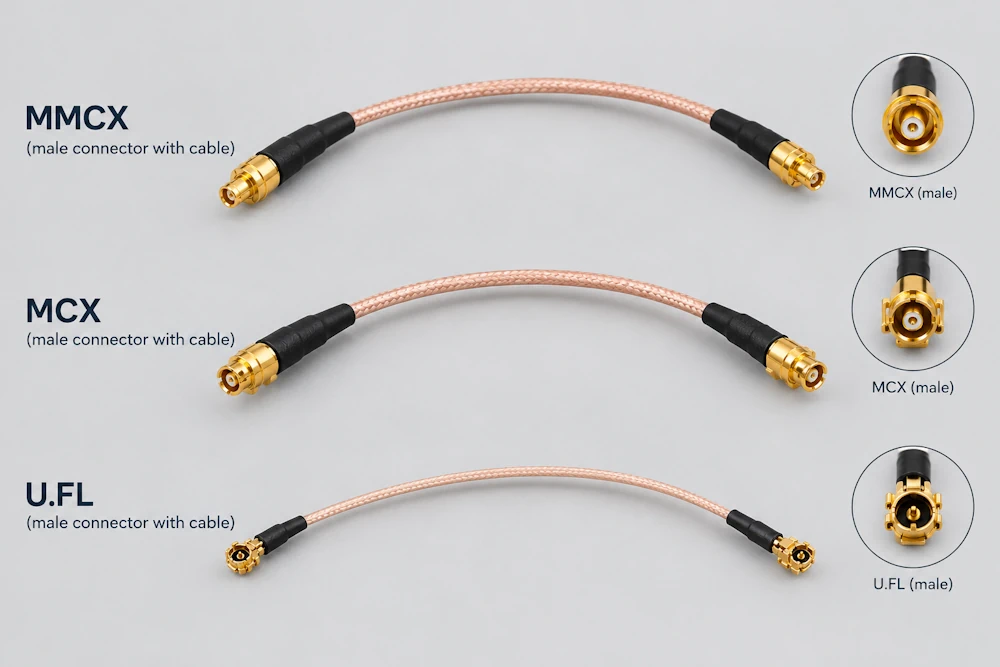
A detent groove plus a spring collar, with a click you hear. Quick, no tools, good for hundreds of cycles, and touchy about side-load when someone pulls the cable sideways to get it off. MMCX, MCX, SMB.
Press fit
An interference fit between shell and receptacle ring, no latch involved. This is the road to the smallest parts, and the toll is around thirty cycles. U.FL, MHF.
Push-on / blind mate
Self-aligning under axial force, forgiving of radial and angular offset. Made for board stacks and fixtures, never for cable you keep unplugging. SMP.
02 / The families
Seven families, plus the ones wearing other names.
Each entry covers where the interface came from and the design squeeze was built to answer.
03 / Comparison table
Seventeen interfaces, side by side.
Published manufacturer specifications, normalized into one table. Filter by family, or search by name, coupling or application. 0 shown.
| Interface | Coupling | Impedance | Max frequency | Mated height | VSWR typ | Mating cycles | Typical cable | Typical use |
|---|---|---|---|---|---|---|---|---|
| MMCX | Snap-on | 50 Ω | 6 GHz | — | 1.30 | ~500 | RG-178, 1.37 mm | GPS & Wi-Fi modules |
| MCX | Snap-on | 50 Ω | 6 GHz | — | 1.30 | ~500 | RG-316, RG-178 | General purpose |
| MCX 75 Ω | Snap-on | 75 Ω | 3 GHz | — | 1.35 | ~500 | RG-179 | DVB & broadcast |
| U.FL | Press fit | 50 Ω | 6 GHz | 2.5 mm | 1.30 | ~30 | 1.13 mm, 0.81 mm | Module to antenna |
| W.FL | Press fit | 50 Ω | 6 GHz | 2.0 mm | 1.35 | ~30 | 0.81 mm | Compact modules |
| AMC | Press fit | 50 Ω | 6 GHz | 2.5 mm | 1.30 | ~30 | 1.13 mm | U.FL equivalent |
| UMCC | Press fit | 50 Ω | 6 GHz | 2.5 mm | 1.30 | ~30 | 1.13 mm | U.FL equivalent |
| HSC | Press fit | 50 Ω | 9 GHz | 1.6 mm | 1.40 | ~30 | 0.81 mm | Low profile |
| MHF I | Press fit | 50 Ω | 6 GHz | 2.5 mm | 1.30 | ~30 | 1.13 mm | U.FL equivalent |
| MHF II | Press fit | 50 Ω | 6 GHz | 2.0 mm | 1.35 | ~30 | 0.81 mm | W.FL equivalent |
| MHF III | Press fit | 50 Ω | 9 GHz | 1.6 mm | 1.40 | ~30 | 0.81 mm | Handsets, tablets |
| MHF 4 | Press fit | 50 Ω | 15 GHz | 1.2 mm | 1.45 | ~30 | 0.81 mm | Ultra low profile |
| MHF 4L | Press fit + latch | 50 Ω | 15 GHz | 1.2 mm | 1.45 | ~30 | 0.81 mm | Automotive, vibration |
| SMA | Threaded | 50 Ω | 18 GHz | — | 1.15 | ~500 | RG-316, RG-405 | Test & external ports |
| RP-SMA | Threaded | 50 Ω | 6 GHz | — | 1.25 | ~500 | RG-316 | Consumer Wi-Fi |
| SMB | Snap-on | 50 / 75 Ω | 4 GHz | — | 1.35 | ~500 | RG-316 | Industrial, rail |
| SMP | Push-on | 50 Ω | 40 GHz | — | 1.30 | 100–1000 | RG-405, semi-rigid | Board stacks, fixtures |
Published manufacturer specifications, typical values · Mated height applies only to board-mounted ultra-miniature types.
04 / Cable pairings
The cable matters as much as the connector.
A flawless termination on the wrong coax still gives up a decibel. Small interfaces are boxed in by cable diameter as much as by their own geometry, and no amount of persuasion gets a connector built for 0.81 mm micro-coax onto RG-316.
| Cable | OD | Loss @ 2.4 GHz | Pairs with |
|---|---|---|---|
| 0.81 mm coax | 0.81 mm | 3.1 dB/m | MHF II–4L, W.FL |
| 1.13 mm coax | 1.13 mm | 2.2 dB/m | U.FL, MHF I, AMC |
| 1.37 mm coax | 1.37 mm | 1.8 dB/m | U.FL, MMCX |
| RG-178 | 1.80 mm | 1.7 dB/m | MMCX, MCX |
| RG-316 | 2.50 mm | 1.1 dB/m | SMA, MCX, SMB |
| RG-179 (75 Ω) | 2.55 mm | 1.3 dB/m | MCX 75 Ω |
05 / Termination
How these connectors attach to cable.
Four methods, each married to a cable diameter and a production volume. The connector makes the choice for you most of the time.
Crimp
A ferrule deformed onto the braid under controlled force. Quick and repeatable on RG-178 and up. What you find on MMCX, MCX and SMA.
Solder
The only workable route below about 1.4 mm OD. Every U.FL and MHF termination goes this way, which is why those parts get built in a factory instead of on a bench in the field.
Surface mount
The receptacle half reflows straight onto the board. Pad geometry comes from the connector, it is not up for discussion, and it fixes your mated height.
Overmould
Strain relief moulded over a termination that already exists. The line between an assembly that shrugs off vibration and one that comes apart in service runs right through here.