Connector plating, materials, and wear: why gold versus nickel matters in tiny RF parts
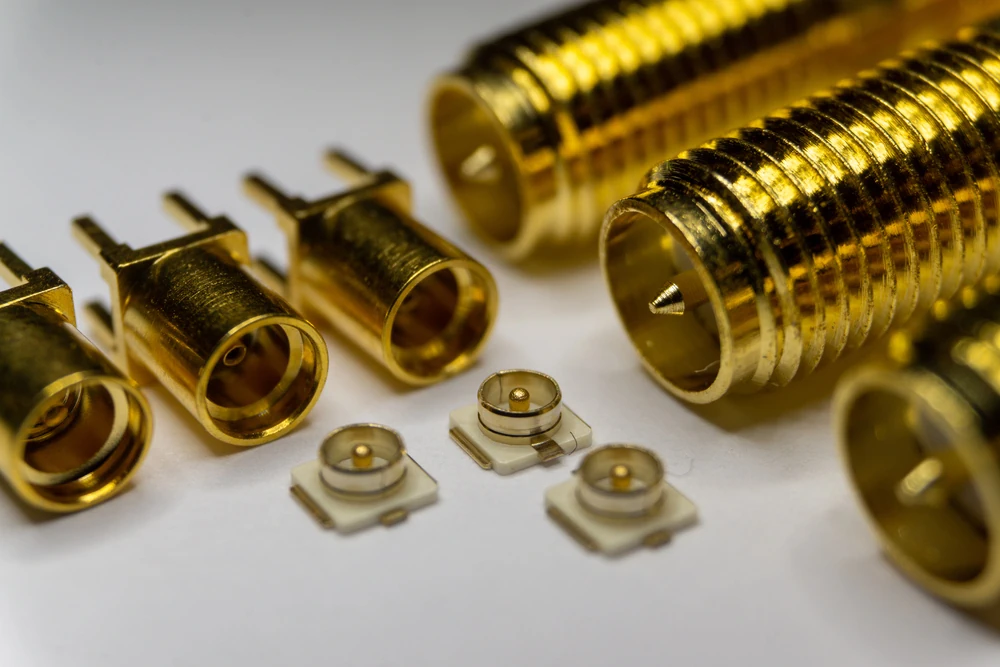
Here's a fact that surprises people who don't spend their days squinting at connector datasheets: the tiny gold-colored ring on your MMCX or SMA jack is often thinner than a soap bubble. Seriously. And that microscopic layer decides if your connector survives fifty matings or five thousand. It also decides if your signal stays clean or starts drifting into weird, hard-to-diagnose noise territory.
We've spent a lot of hours at Green Button pulling connectors apart, cross-sectioning them, and watching plating wear under a microscope like it's the season finale of something. So let's talk about why gold versus nickel isn't some trivial spec-sheet footnote. It's frequently the actual limiting factor in how long your RF interconnect survives in the field.
Why plating punches above its weight in miniature connectors
Shrink a connector down to MMCX or U.FL size and you shrink the contact area right along with it. Less surface area means whatever current or signal passes through gets concentrated into a smaller patch of metal. Mechanical stress follows the same logic. Every mating cycle wipes across a shorter path, and there's less material margin before you hit bare substrate.
RF signals are picky about surface quality too. Skin effect pushes current toward the outer few microns of a conductor, especially as frequency climbs, so the plating is practically the signal path itself. Scratch through it, expose oxidized base metal, and you'll see the classic symptoms: intermittent contact that comes and goes with temperature or vibration, insertion loss that creeps upward over months, and fretting corrosion that shows up as a fine reddish-brown dust if you ever pop one open.
The metals underneath the shine
Most RF contacts start life as beryllium copper, prized for its springiness and fatigue resistance. It's the metal doing the actual work of gripping the mating pin.
Phosphor bronze shows up as the budget-conscious cousin, offering decent resilience without BeCu's price tag.
Brass tends to handle connector bodies and less demanding pins where springback matters less.
Substrate choice interacts with plating in ways that aren't obvious until something fails, though. Hardness mismatches, galvanic pairings between dissimilar metals, solderability quirks, and more. So, a gorgeous gold finish over a poorly chosen substrate is basically lipstick on a structural problem.
Gold, nickel, and the also-rans
Gold gets the reputation it has because it earns it. It doesn't oxidize, it keeps contact resistance low and wonderfully stable, and it shrugs off humidity and salt air in a way other metals simply can't match. The catch is cost, obviously, but also softness. A gold flash layer wears through embarrassingly fast, and once it's gone, you might be relying on whatever's underneath to save you.
Nickel is the workhorse nobody gets excited about. Hard, wear-resistant, cheap, and it makes a fantastic barrier layer beneath softer platings. But it's not noble in the chemistry sense, meaning it will oxidize given enough time and moisture, and its contact resistance runs higher than gold's. Expose bare nickel on a mating surface and you've quietly degraded your RF performance without any obvious external sign.
Silver conducts beautifully but tarnishes with sulfur exposure, so you'll mostly see it tucked beneath gold rather than out front.
Tin is cheap and plays nice with solder, but it flakes apart under fretting motion and has no business on a mating surface that sees repeated cycles.
Rhodium and its exotic cousins deliver serious hardness and wear life, at a price that keeps them reserved for niche, high-reliability applications.
The plating stack: it's not just one layer
"Gold" on a spec sheet can mean wildly different things. Flash gold is a whisper-thin layer, cheap and quick to wear away. Soft gold has more body to it and conducts well but still isn't built for heavy cycling. Hard gold, alloyed for durability, is what you want if the connector is going to see real mating cycles in a lab or field environment.
Most quality connectors run gold over a nickel underplate, and there's good reason for that pairing. Nickel acts as a diffusion barrier, stopping base metal migration and giving the soft gold something firm to sit on. The catch, and this is the part that trips people up, is what happens once that gold layer wears through. Suddenly you're mating against nickel, and your contact resistance and corrosion behavior just changed without anyone updating the spec sheet.
Electroless nickel immersion gold, borrowed from PCB finishing, shows up occasionally too, with its own thickness and uniformity trade-offs worth asking your supplier about directly.
What this does to your actual RF performance
Contact resistance is the headline concern, and gold keeps it low and remarkably stable across time. As frequency rises, surface finish matters more because of that skin effect concentration we mentioned earlier. VSWR and insertion loss stay minimal while plating remains intact, but oxidized nickel or tarnished silver peeking through worn spots will nudge both numbers in the wrong direction. Worth a mention too: nickel is ferromagnetic, and while thin coatings rarely cause trouble, sensitive systems occasionally notice it.
Wear, cycles, and the honest lifespan question
Connectors generally fall into rough buckets: low-cycle designs rated under 100 matings, mid-cycle in the hundreds, and high-cycle parts built for thousands. U.FL and IPEX sit firmly in the low-cycle camp, which is exactly why they're often speced with thin gold flash rather than anything heavier. SMA and SMP, expected to survive repeated bench testing and field servicing, typically justify thicker hard-gold plating over nickel.
Wear itself shows up as abrasion, adhesive transfer between mating surfaces, fretting corrosion from tiny repeated micro-movements, and eventually plastic deformation of the spring contacts themselves once they've lost their springback.
Environment throws its own curveball
Salt air and humidity favor noble platings without question. Watch for galvanic corrosion risk when dissimilar metals end up bolted together, particularly connectors mounted against stainless or aluminum housings. RoHS-driven lead-free soldering has also nudged plating choices over the years, since some finishes behave differently under lead-free reflow temperatures. Thermal cycling adds mechanical fatigue to plated contacts too, something easy to overlook until a part fails after its tenth summer-to-winter swing.
Picking plating for your own project
Ask yourself honestly: how many mating cycles will this actually see? What environment is it living in? What's your budget per unit, and how electrically sensitive is the link?
From there, request specifics from suppliers rather than accepting "gold plated" as an answer. Ask for the plating stack itself, something like 1 micron gold over 3 to 5 microns nickel - this varies by manufacturer. Ask about thickness tolerance for electro/electroless plating, mating cycle ratings, and test data covering XRF thickness verification, salt spray results, and insertion loss measured before and after life testing.
A cheap trick worth knowing: spot-plating just the contact region rather than the entire part saves money without sacrificing performance where it counts.
Quick notes by connector family
U.FL, IPEX, and MHF are tiny and cycle-limited, so gold flash is standard and nobody should expect heroic mating life from them. MMCX and MCX sit in the middle, and hard gold earns its keep here if you're reconnecting these parts repeatedly. SMA, SMB, and SMP tend toward higher cycle counts, and gold over nickel with a hard-gold topcoat is the sensible default for anything touched often on a bench or in the field. Watch especially for partial wear that exposes nickel in vibration-heavy assemblies, that's where intermittent failures love to hide.
What we actually watch for on the bench
Our own testing routine includes insertion and extraction cycling, RF sweeps before and after that cycling, contact resistance measurement, and cross-sectioning failed samples under a scope. Red flags in incoming lots include gold feathering at the edges, suspiciously thin flash layers, inconsistent contact force between samples, and VSWR that drifts after just a handful of mating cycles.
The short version
Gold buys you stable, low resistance contact and genuine corrosion resistance, at a cost, and often in a layer thinner than you'd like. Nickel is tough and cheap but turns electrically unfriendly the moment it's exposed to the mating surface. Figure out your expected cycle count, your environment, how electrically sensitive your link really is, and your budget, then specify the actual plating stack and demand test evidence to back it up.
Browse our connector-specific pages for per-type plating recommendations, and keep an eye out for our upcoming spec template for sourcing RF parts without getting burned by a datasheet that says "gold" and means almost nothing by it.