Between-series
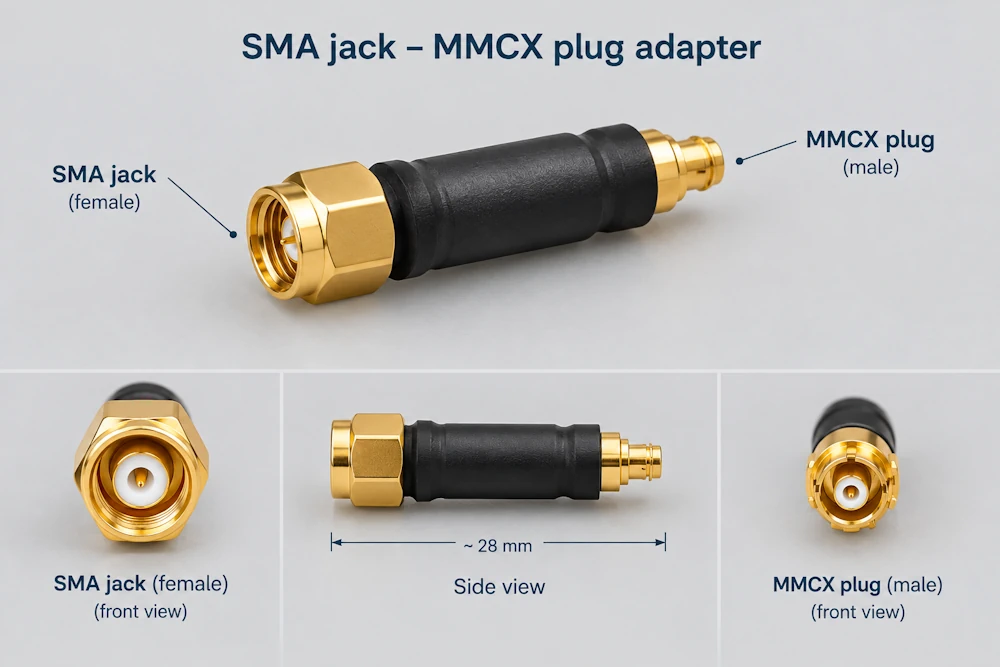
Different interface at each end. SMA to MMCX, MCX to U.FL. Biggest category, and the one where loss scatters hardest.
Home / RF Adapters
Between-series transitions, in-series couplers, terminations and attenuators. What each one does to your signal, and when reaching for one is the wrong move.
An adapter is two connectors plus a short transmission line doing an impression of nothing. Out in the real world it charges you somewhere between 0.05 dB and 0.6 dB depending on the pairing and where you are in the band, and it hands you a second mechanical joint with its own opinions about vibration. Use adapters. Just know the number before one ends up buried in a signal path you cannot reach.
01 / Categories
Different interface at each end. SMA to MMCX, MCX to U.FL. Biggest category, and the one where loss scatters hardest.
Same interface both ends. Barrels, bulkhead feed-throughs, gender changers. For stretching a run or dragging it through a panel.
50 and 75 Ω loads. They close out unused ports and let you characterize a fixture before you decide to believe anything measured through it.
Loss you asked for, specified and repeatable, generally 1 to 30 dB. They keep a receiver front end alive or flatten a test path. Interface changes are somebody else's job.
02 / Transition matrix
Insertion loss measured at 6 GHz on a calibrated two-port sweep, mean of ten samples per combination. 0 shown.
| Interface A | Interface B | Form | Impedance | Usable to | IL @ 6 GHz | VSWR typ | Notes |
|---|---|---|---|---|---|---|---|
| SMA jack | MMCX plug | Rigid, straight | 50 Ω | 6 GHz | 0.12 dB | 1.35 | Well behaved |
| SMA plug | MMCX jack | Rigid, right angle | 50 Ω | 6 GHz | 0.18 dB | 1.40 | Bend adds loss |
| SMA jack | MCX plug | Rigid, straight | 50 Ω | 6 GHz | 0.14 dB | 1.35 | Well behaved |
| SMA jack | SMB plug | Rigid, straight | 50 Ω | 4 GHz | 0.16 dB | 1.40 | SMB limits range |
| SMA jack | SMA jack | Bulkhead | 50 Ω | 18 GHz | 0.05 dB | 1.15 | Best in class |
| SMA jack | SMP plug | Rigid, straight | 50 Ω | 18 GHz | 0.11 dB | 1.30 | Fixture use |
| MMCX jack | MMCX jack | Barrel | 50 Ω | 6 GHz | 0.08 dB | 1.30 | In-series |
| MMCX plug | MCX jack | Rigid, straight | 50 Ω | 6 GHz | 0.15 dB | 1.40 | Both snap-on |
| MMCX jack | U.FL plug | Pigtail, 60 mm | 50 Ω | 6 GHz | 0.26 dB | 1.50 | Cable dominates |
| MCX jack | MCX jack | Barrel | 50 Ω | 6 GHz | 0.09 dB | 1.30 | In-series |
| MCX jack | MCX jack | Barrel | 75 Ω | 3 GHz | 0.11 dB | 1.35 | Do not mix with 50 Ω |
| MCX jack | U.FL plug | Pigtail, 60 mm | 50 Ω | 6 GHz | 0.28 dB | 1.50 | Cable dominates |
| U.FL jack | U.FL jack | Coupler | 50 Ω | 6 GHz | 0.19 dB | 1.45 | Uncommon in production |
| U.FL plug | MHF 4 plug | Pigtail, 80 mm | 50 Ω | 9 GHz | 0.34 dB | 1.55 | Bridges incompatible types |
| MHF 4 plug | SMA jack | Pigtail, 100 mm | 50 Ω | 15 GHz | 0.31 dB | 1.50 | Common external port |
| U.FL plug | RP-SMA jack | Pigtail, 150 mm | 50 Ω | 6 GHz | 0.29 dB | 1.50 | Consumer Wi-Fi |
n = 10 per combination · Pigtail figures include the cable, which usually dominates · See methodology
03 / Judgement
Bench fix, or permanent?
On a bench, live your life. Sealed inside an enclosure for the next eight years, a directly terminated assembly wins that argument on engineering merit nearly every time.
How high does it have to go?
Below 3 GHz, almost any pairing in the matrix behaves. Past 6 GHz, pigtail transitions start eating the loss budget and the mean turns into a number you should stop quoting on its own.
What mechanical load will it see?
An adapter doubles the joint count in that stretch of path. Handled, shaken, routed around a corner? The second joint is where fretting and slow loosening announce themselves first.
04 / At a glance